
The Stamford Courthouse Role in Custody
Stamford has no county jail and no county sheriff. Connecticut merged all county jails and state prisons into one state agency in 1968. So custody after a Stamford arrest does not run through a county roster. It runs through the police, the court, and the Connecticut Department of Correction. Geographical Area No. 1 at Stamford, known as GA 1, is the criminal court in that chain. The Connecticut Judicial Branch runs it, and Judicial Marshals staff the building and its lockup.
A person taken into custody after a Stamford arrest is brought to GA 1 for a first court appearance. Judges, prosecutors, clerks, and Bail Services all work from this courthouse. The court does not store people long term. It holds defendants only while their cases are heard. When court is done, the person is freed on conditions or sent to state custody. For Stamford defendants who stay locked up, that means CT DOC and Bridgeport Correctional Center.
The arraignment is the first court date after an arrest. The Judicial Branch victim guide says an in-custody defendant, or one charged with a domestic-violence crime, is arraigned the next court business day. That tight timing matters. Many Stamford arrests move fast from a police cell to this court. So a family question that sounds like a jail search is often a court-date question.
Who Passes Through the Court Lockup
The court lockup at GA 1 is a holding area, not a jail with a public capacity. The research found no published lockup capacity for this courthouse, and none should be assumed. People pass through it for short stretches tied to their court events. A defendant held before arraignment waits in lockup for the case to be called. After the judge acts, the marshal either processes a release or arranges a transfer.
The people who move through GA 1 fall into a few groups. Knowing the group helps you guess where to look next for a defendant.
- Newly arrested defendants brought in for arraignment, often the next court business day.
- Defendants who got a summons or a written promise to appear and arrive on their own.
- People on bond who return for later court dates and stay free that day.
- Defendants who cannot post bail and are moved to CT DOC custody after court.
- People held on a warrant, a capias, or a violation-of-probation matter.
A defendant who is released walks out from the courthouse. A defendant who is held does not stay at 123 Hoyt Street. The state moves that person to a correctional center. For Stamford court, CT DOC names Bridgeport Correctional Center as the facility that serves the case load. That is where a held Stamford defendant most often lands, so check the state inmate search there once a transfer is likely.
Note: Confirm a defendant's hearing date and current custody with the GA 1 clerk before you travel, because court schedules and custody status can shift the same day.
How to Find a Stamford Criminal Case
Because there is no roster, the case record is your lookup. The Judicial Branch case lookup is the public entry point. It splits into two paths. One path covers pending cases that are still active. The other covers convictions that have already been decided. You pick the path that fits where the case stands. For Stamford matters, the court location filter narrows results to this courthouse.
The convictions search by defendant uses a small set of fields. You can search by last name, first initial, and birth year, and you can pick a court location and a category type. The court list is long, and Stamford appears twice as separate choices. Read the field table before you search so the filters make sense.
| Field | Required | Notes |
|---|---|---|
| Last Name (begins with) | Required | Matches names that start with the letters you enter. |
| First Initial | Optional | Narrows by the first letter of the first name. |
| Birth Year | Optional | Year only, with an optional plus or minus range. |
| Court Location | Optional | Choose Stamford Geographical Area 1 or Stamford Judicial District. |
| Category Type | Optional | Criminal or Motor Vehicle. |
Online lookup is a public service, not the official court record. The Judicial Branch disclaimer states that plainly. Criminal history changes daily through erasures, corrections, and pardons. Some matters never show online at all, such as youthful offender, juvenile, and infraction records. For a formal record, the Court Records FAQ says to file a written request at the GA court where the arrest happened. Use the steps below for that request.
- Identify the court. For Stamford arrests, start with GA 1 at Stamford, court code S01S, and the Stamford-Norwalk Judicial District for serious cases.
- Search pending cases first if the matter is active, then run the convictions search if it has been decided.
- Set the court-location filter to the place of arrest, since the arrest location, not the home town, controls the court.
- Write to the GA court where the arrest occurred for the official record, including the name, date of birth, and date of arrest or disposition.
The case-search how-to is covered in more depth on the court records after jail arrest page, including charging documents and charge status. Use the GA 1 clerk when the online result is unclear. The clerk can confirm what the public file shows and what the next court date is.
Arraignment and What Happens in Court
The arraignment is the first court date after an arrest. It is where the formal charges are read and early decisions about release are made. The judge reviews the case to confirm there is enough to charge the defendant. The prosecutor may keep the charges, change them, reduce them, or drop them as the facts develop. A charge at arrest is not a conviction, and the court file, not a custody screen, shows where a case stands.
Timing depends on the defendant's status. An in-custody defendant is arraigned the next court business day. A domestic-violence case follows the same next-day rule. A defendant who received a summons appears on the date and time printed on that summons. Those rules push many Stamford cases into GA 1 quickly, which is why the clerk and the case lookup answer the custody question better than any roster would.
Several offices share the arraignment work. The clerk manages the file and the docket. Bail Services reviews release. The State's Attorney handles the prosecution. The court can also set nonfinancial conditions, such as no-contact orders, supervision, or treatment, instead of or alongside a money bond. A defendant who cannot meet the set conditions is held and moved to CT DOC.
Bail Services and Posting Bail at Court
Connecticut uses police-set bail, a bail-staff review, and court-set conditions. There is no county jail bonding desk. The Judicial Branch bail FAQ says police can set a bail amount at the time of arrest. If the defendant cannot make that amount, police must notify Bail Staff. Pretrial Services staff then interview the defendant, gather background, and review the police-set figure. Staff can raise or lower the amount the police set. At GA 1, Bail Services handles this work, and the courthouse Bail Services line is the place to ask about it.
There is more than one way to post. The choice depends on the bond and the case.
| Option | What It Means |
|---|---|
| Promise to appear | Release on a written promise, with no money posted. |
| Nonfinancial conditions | Release with rules such as no-contact, supervision, or treatment. |
| Cash or full value | The full bond amount paid in cash. |
| 10 percent cash option | Available since January 1, 2020 for bail set at $20,000 or less, with exceptions. |
| Surety bond | Posted through a licensed bondsperson or agent. |
| No release or hold | May apply under warrant terms, a court order, or another agency hold. |
Where you post bail depends on where the person sits at that moment. The bail FAQ says bail may be posted at the police department where the client is locked up, at a courthouse, or at the Department of Correction facility holding the client. For a Stamford case, that can change by the hour. A family member may need to ask whether the person is still at Stamford Police, has been brought to 123 Hoyt Street, or has been transferred to Bridgeport CC. Cash bail or the 10 percent money comes back when a diversionary program is granted, on acquittal, on dismissal, or when the court sentences the person.
Note: Call Bail Services or the clerk to confirm where a defendant is held before posting, since the right place to pay changes as the person moves through processing.
Towns and Case Types GA 1 Covers
GA 1 at Stamford serves eight lower Fairfield County towns. The court covers Darien, Greenwich, New Canaan, Norwalk, Stamford, Weston, Westport, and Wilton. An arrest in any of those towns can route to this courthouse. The case type then decides whether GA 1 keeps it or sends it up to the Judicial District. Both courts work out of 123 Hoyt Street, so the address stays the same even when the part changes.
Connecticut splits criminal work into Part A and Part B. The State's Attorney office page explains the divide. GA 1 is the Part B court for the district. More serious matters move to Part A in the Stamford-Norwalk Judicial District. The table below shows the split.
| Part A (Judicial District) | Part B (GA 1) |
|---|---|
| More serious criminal cases | Arraignments and first appearances |
| Mostly class A and class B felonies | Class C, D, and E felonies |
| Drawn from all towns in the district | Misdemeanors and infractions |
| Handled by the Part A prosecutors | Motor vehicle offenses |
This split affects your case search. The convictions lookup lists Stamford Geographical Area 1 and Stamford Judicial District as separate court locations. If you do not know which part holds a case, check both. A case can start at GA 1 and later move to Part A as it grows more serious, so the same defendant may show under more than one location.
Stamford Courthouse Contacts and Offices
One building at 123 Hoyt Street holds several offices that each handle a piece of a case. The Chief Clerk manages the criminal file and the docket. Bail Services reviews release. Adult Probation supervises people on probation. The Court Service Center helps self-represented people, and the Law Library supports legal research. The two contact cards below give the courthouse and the prosecutor.
Geographical Area No. 1 at Stamford
123 Hoyt Street
Stamford, CT 06905
Chief Clerk (203) 965-5208
Bail Services (203) 965-5248
Hours 9:00 a.m. to 5:00 p.m.; doors open 8:30 a.m.
State's Attorney, Stamford/Norwalk
123 Hoyt Street
Stamford, CT 06905
Office (203) 965-5215
GA 1 Office (203) 965-5255
Part A and Part B prosecution
The Connecticut Division of Criminal Justice runs the prosecution side. The State's Attorney is the chief prosecutor for the district, appointed by the Criminal Justice Commission rather than elected. Paul J. Ferencek holds the post through June 30, 2026. The commission appointed David R. Applegate on May 7, 2026 to succeed him. The full office directory below lists the working phone and fax lines at the courthouse.
| Office | Phone |
|---|---|
| Chief Clerk | (203) 965-5208 |
| Bail Services | (203) 965-5248 |
| Adult Probation | (203) 965-5302 |
| Court Service Center | (203) 965-5328 |
| Law Library | (203) 965-5250 |
| Clerk Fax | (203) 965-5355 |
Note: Each office handles a different part of a case, so confirm which line fits your question before you call to avoid being routed twice.
Getting to Stamford Superior Court
The courthouse sits at 123 Hoyt Street in downtown Stamford. The Judicial Branch publishes practical access details for visitors. The official directions page lists parking garages, transit, and accessible-entrance notes. The image below comes from that page.
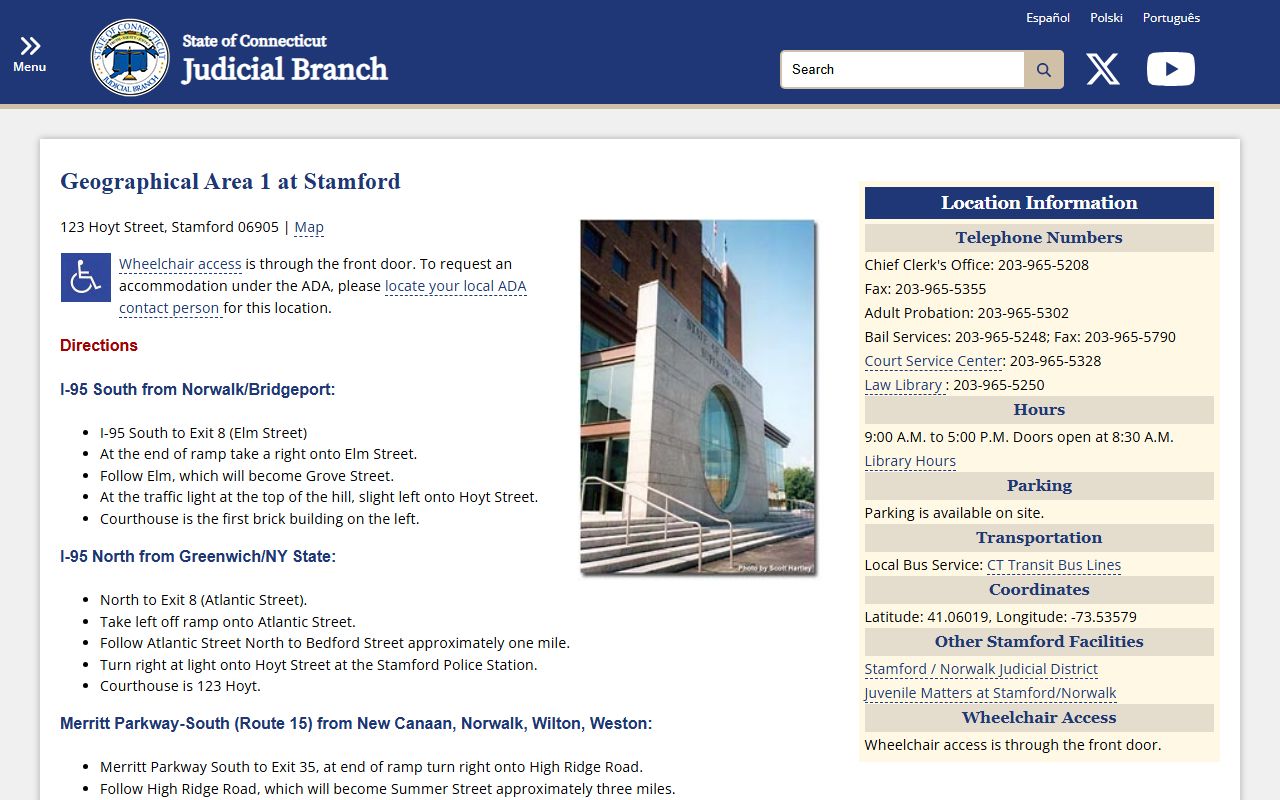
That page is the source for the travel facts here. It helps a visitor plan a court date without guessing about parking or the entrance. The details below come straight from it.
| Item | Detail |
|---|---|
| Court hours | 9:00 a.m. to 5:00 p.m.; doors open 8:30 a.m. |
| Summer Street Garage | 100 Summer Street, 0.1 mile away |
| Bell Street Garage | 28 Bell Street, 0.3 mile away |
| Train station | About 0.6 mile from the courthouse |
| Bus stop | One block away |
| Accessible entrance | Wheelchair access through the front entrance |
| Handicap parking | Across the street in the municipal lot |
Paid parking is available in municipal garages and metered spaces near the building. Juror parking is offered at the Bell Street and Summer Street garages. Many visitors arrive by train, since the station sits less than a mile away and a bus stop is one block off. Plan to arrive before doors open at 8:30 a.m. so security and the right courtroom do not eat into your court time.
After Court: Transfer or Release
What happens after a hearing comes down to the release decision. A defendant who meets the conditions leaves the courthouse. A defendant who cannot meet them is held. The court itself does not keep held people. The marshals process a transfer into CT DOC custody, and for Stamford cases that custody usually means Bridgeport Correctional Center. CT DOC names Bridgeport CC as the facility serving Stamford Superior Court.
Once a person is in state custody, the lookup changes. The court file still shows the case, but custody now shows in the CT DOC inmate search. That search runs by name, date of birth, or DOC number, and it updates daily rather than in real time. A newly transferred Stamford defendant may not appear at once. The Bridgeport Correctional Center page covers how to look someone up there, what the profile shows, and how visits and accounts work. CT DOC also notes that current custody does not by itself prove a conviction, since its facilities hold accused people awaiting trial.
For ongoing tracking, register with Connecticut VINE rather than checking a screen over and over. VINE sends automated notices about custody and court events. CT DOC notes that VINE offers separate registration paths for offenders and for offenders with court cases, so you may need to sign up under both to cover a Stamford case fully.