
Stamford Court Records After a Jail Arrest
A Stamford arrest does not create a county jail record, because Connecticut runs one unified state correction system. The state folded all county jails into the Department of Correction in 1968. So the trail of court records after an arrest runs through the Connecticut Judicial Branch, not a county clerk. Stamford Police may arrest and process a person first. The case then moves to criminal court. A prosecutor reviews the facts and files the charges. Those charges become the official court record for the case, and they can differ from the offense listed at booking.
The booking side and the court side answer different questions. For who is in custody right now, see the jail inmate records page, which covers the state inmate search and the local police records unit. For booking photos, see the jail mugshots page. This page stays on the court record itself. It explains how charges get filed after an arrest, how to look up the case, what each charge status means, how bond works, and how warrants and erasure shape what the public can see.
From a Stamford Arrest to GA 1 Arraignment
The first court date after an arrest is the arraignment. Stamford and the towns around it are served by Geographical Area No. 1 at Stamford, the criminal court at 123 Hoyt Street. The Judicial Branch victim guide explains the timing. If the defendant is held in jail, or if the matter is a family violence case, the arraignment falls on the next court business day. A person who got a summons instead appears on the date written on it. So a fresh arrest often reaches court fast.
At arraignment a judge reviews the case to confirm there is enough evidence to charge the person. The prosecutor may proceed, amend, reduce, dismiss, or later nolle the charges as the case develops. If the person is not released, custody passes to the Connecticut Department of Correction. The agency identifies Bridgeport Correctional Center as the facility that serves Stamford Superior Court. The custody record there is a state record. The charge record stays with the court.
Connecticut law shapes this release decision. Under Conn. Gen. Stat. § 54-64a, the judge must release a person charged with a bailable offense on the least restrictive condition that still secures appearance and public safety.
Note: A booking entry can appear on a state inmate search hours before the arraignment is held, so the court record may lag the custody record at first.
Stamford and Norwalk Prosecutor Offices
Connecticut does not elect prosecutors. The Criminal Justice Commission appoints them, which makes the state one of the few that do not put chief prosecutors on the ballot. The office that charges Stamford arrests is the Office of the State's Attorney for the Judicial District of Stamford/Norwalk. It serves Darien, Greenwich, New Canaan, Norwalk, Stamford, Weston, Westport, and Wilton. The State's Attorney is the chief prosecuting attorney for the district. You can read its office and court details on the Division of Criminal Justice page for the district.
The Stamford/Norwalk office sits inside the prosecutor pages of the state Division of Criminal Justice. The image below comes from that official source.
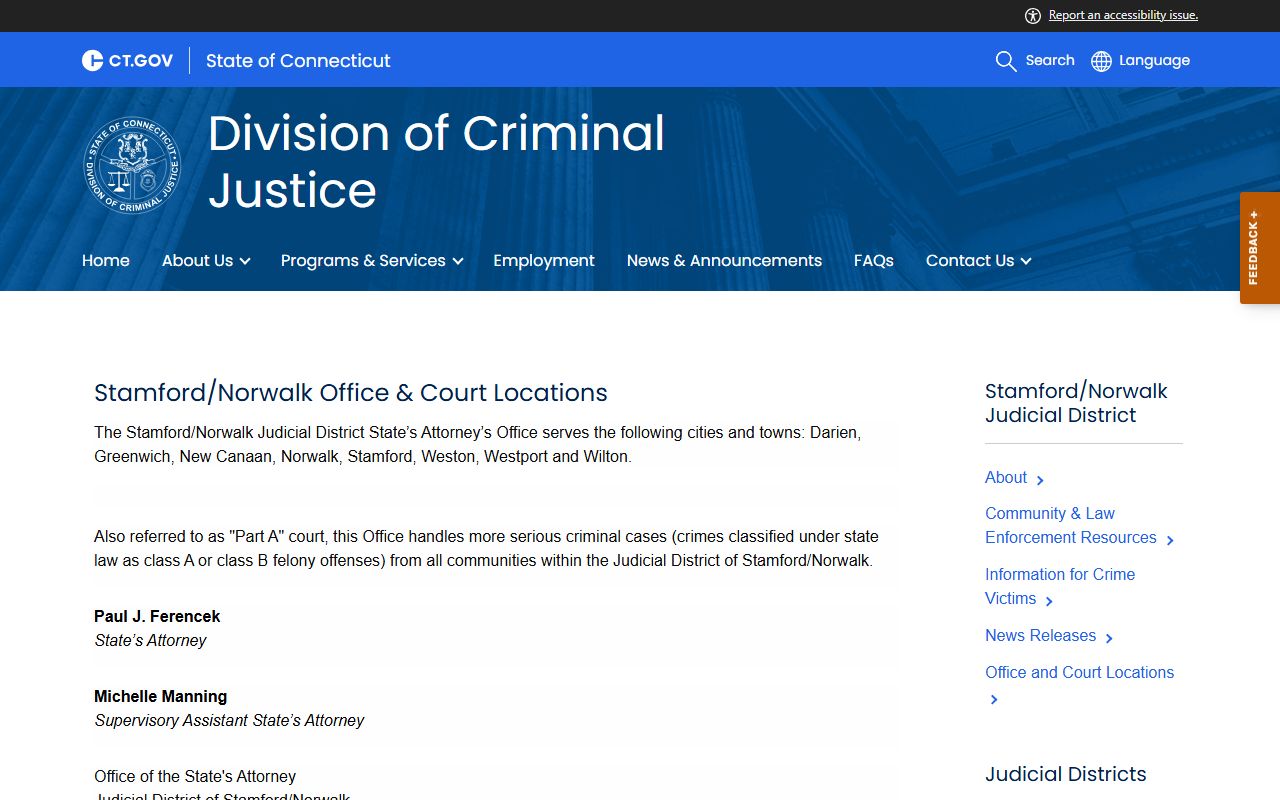
Leadership is in transition during 2026. Paul J. Ferencek remains the incumbent State's Attorney until his retirement, effective June 30, 2026. On May 7, 2026, the Criminal Justice Commission appointed David R. Applegate to succeed him. The office oversees prosecutors who handle Judicial District and Juvenile Matters work in Stamford, plus the GA court in Stamford. Who decides on a charge does not change the public record itself, but it does explain why charging choices can shift between offices.
How to Find Stamford Court Records After an Arrest
Court records after an arrest live in the Connecticut Judicial Branch case lookup, not on a county jail roster. The lookup landing page links separate searches for pending criminal and motor vehicle cases and for criminal convictions. Booking and arrest detail still sit on the custody side. The court record shows the filed charges, court dates, bond, and disposition. Start at the official Judicial Branch case lookup page, shown below.
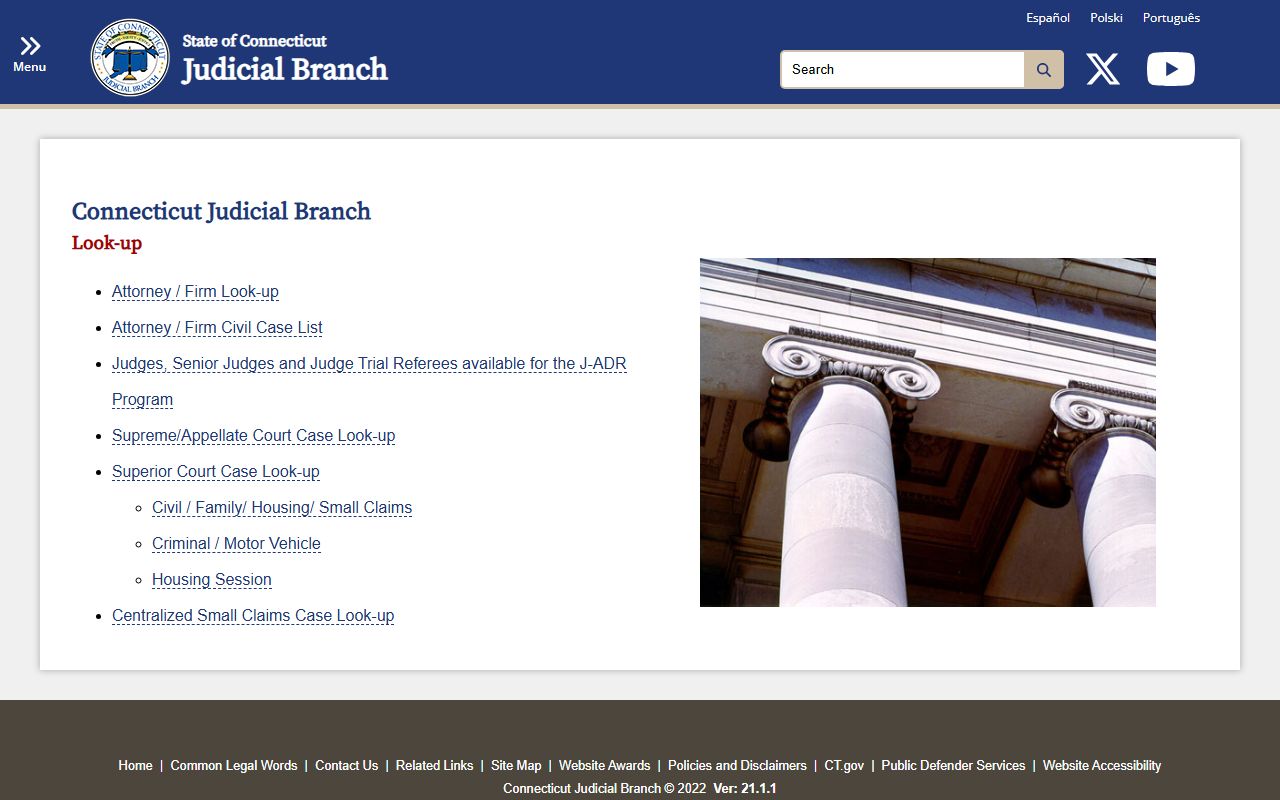
That landing page is the entry point for both active cases and closed cases that ended in conviction. Work the search in order rather than guessing.
- Open the Judicial Branch case lookup and pick the criminal or motor vehicle option that fits the case.
- Search pending cases by defendant name or docket number if the matter is still active.
- Open the case and read the full list of charges the prosecutor filed.
- Check each charge for its statute, level, and current status, then note the court dates and disposition.
For a closed case, use the convictions search instead. It applies time and category limits, so a recent arrest that has not reached a conviction will not appear there. Online conviction data generally displays no more than ten years after sentencing. The Judicial Branch disclaimer also warns that the online lookup is a public service, not the official court record.
Court Search Fields and Location Filters
The convictions search by defendant uses a short set of fields. You do not need every field, but a court location helps narrow a common name. The defendant convictions search by name is shown below.
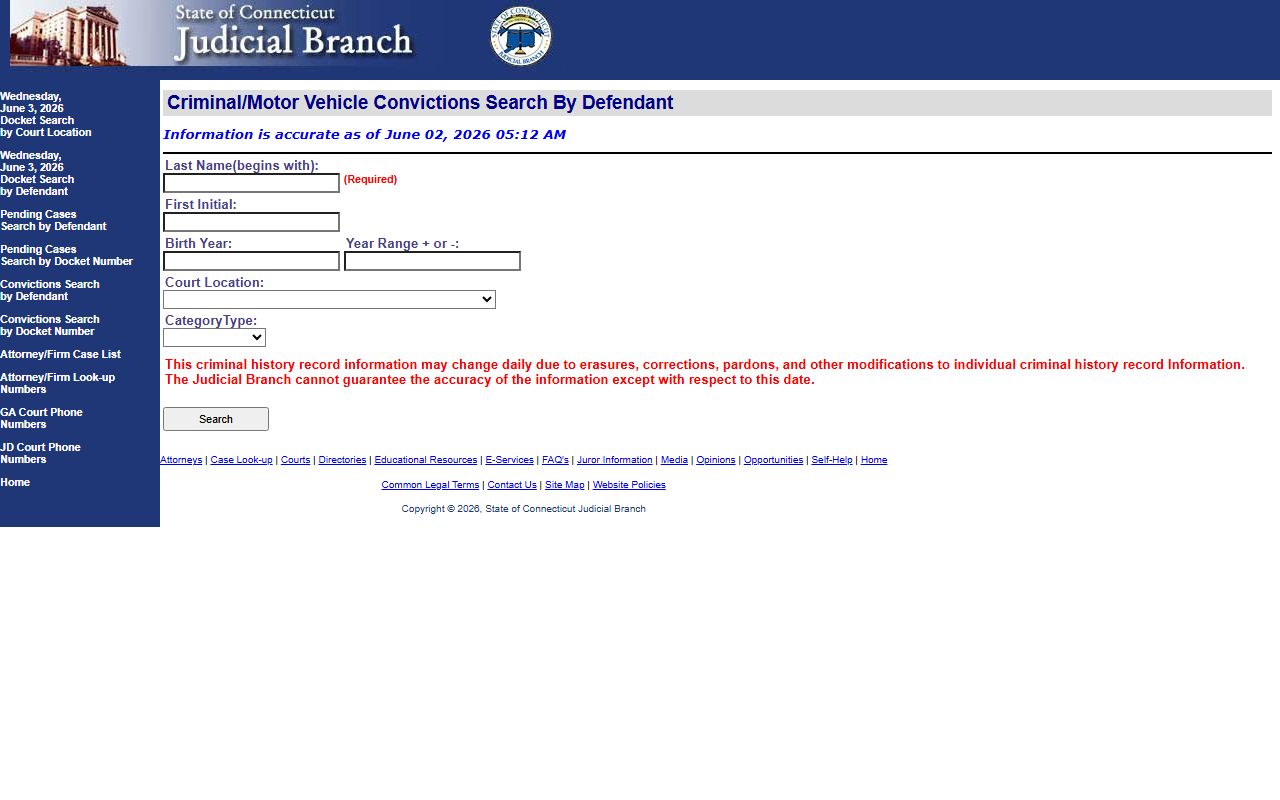
The fields below match the visible criminal and motor vehicle convictions search on the Judicial Branch site.
| Field | Type | Required | Notes |
|---|---|---|---|
| Last Name (begins with) | Text | Yes | Search begins with the last-name letters you enter. |
| First Initial | Text | No | Narrows the result by first initial. |
| Birth Year | Text | No | Year only. |
| Year Range + or - | Range | No | Expands the birth-year window. |
| Court Location | Dropdown | No | Includes Stamford GA 1, Stamford Judicial District, Norwalk GA 20, and many others. |
| Category Type | Choice | No | Criminal or Motor Vehicle. |
Use the location filter with care. "Stamford Geographical Area 1" and "Stamford Judicial District" are two separate options in the dropdown. If a person lives in Stamford but the arrest happened in another town, search the court for the arrest location instead. The GA 1 Stamford court code is S01S.
How Charges Get Filed After an Arrest
Connecticut does not follow the standard complaint, information, and grand-jury indictment model that many states use. Charges flow through the court. After the arrest and any police-set bail, bail staff may review the amount. At arraignment, a judge reviews whether the evidence supports the charge. The prosecutor then drives the charge: proceed, amend, reduce, dismiss, or nolle. The case routes to one of two tracks based on how serious the offense is.
The Division of Criminal Justice splits the work into Part A and Part B. The table compares the two so you know which court holds the record.
| Part A (Judicial District) | Part B (GA No. 1) | |
|---|---|---|
| Handles | More serious cases | Less serious cases |
| Typical Charges | Mostly class A and B felonies | Class C, D, E felonies, misdemeanors, infractions, motor vehicle |
| Court | Stamford/Norwalk Judicial District | GA No. 1 at Stamford |
| Reach | All towns in the district | All towns in the district |
A case can start at the GA court and move to Part A as the facts develop. So the court location for a record may shift once. When you cannot find a serious felony in the GA listing, check the Judicial District option for the same person.
Charge Status and What It Means
Charges change as a case moves. The offense at booking can read differently from the charge the prosecutor finally files. A charge may be amended, reduced, or dropped. The court record uses plain status terms, and each one carries a different meaning for the case and for later record access. The list below defines the terms you will see most often.
| Status | What It Means |
|---|---|
| Pending | The charge has not reached a final disposition yet. |
| Nolle Prosequi | The prosecutor declines to keep prosecuting; erasure timing rules may apply after a set period. |
| Dismissed | The court or prosecutor ends the charge; erasure rules may follow once it is final. |
| Amended / Substituted | The prosecutor changes the charge language, count, or statute. |
| Reduced | The charge is lowered from a more serious offense to a less serious one. |
| Disposed | The court has taken final action on the charge or case. |
| Conviction | A plea or finding of guilt; this differs from an arrest or accused status. |
| Failure to Appear | A missed court date; it can trigger a rearrest warrant and bond forfeiture. |
A pending status is not a conviction. It only means the case is open. Watch the disposition line, since that is where the case truly resolves.
Bond and Release After a Stamford Arrest
Connecticut sets bail through police, then bail staff, then the court, rather than at a county jail bonding desk. The Judicial Branch bail FAQ explains the flow. Police set a bail amount at arrest. If the person cannot make that amount, police must notify Bail Staff. Pretrial Services staff then interview the person, gather details, and review the police-set amount. They can raise or lower it. Bail may be posted at the police department, at a courthouse, or at the DOC facility holding the person. The bail FAQ is shown below.
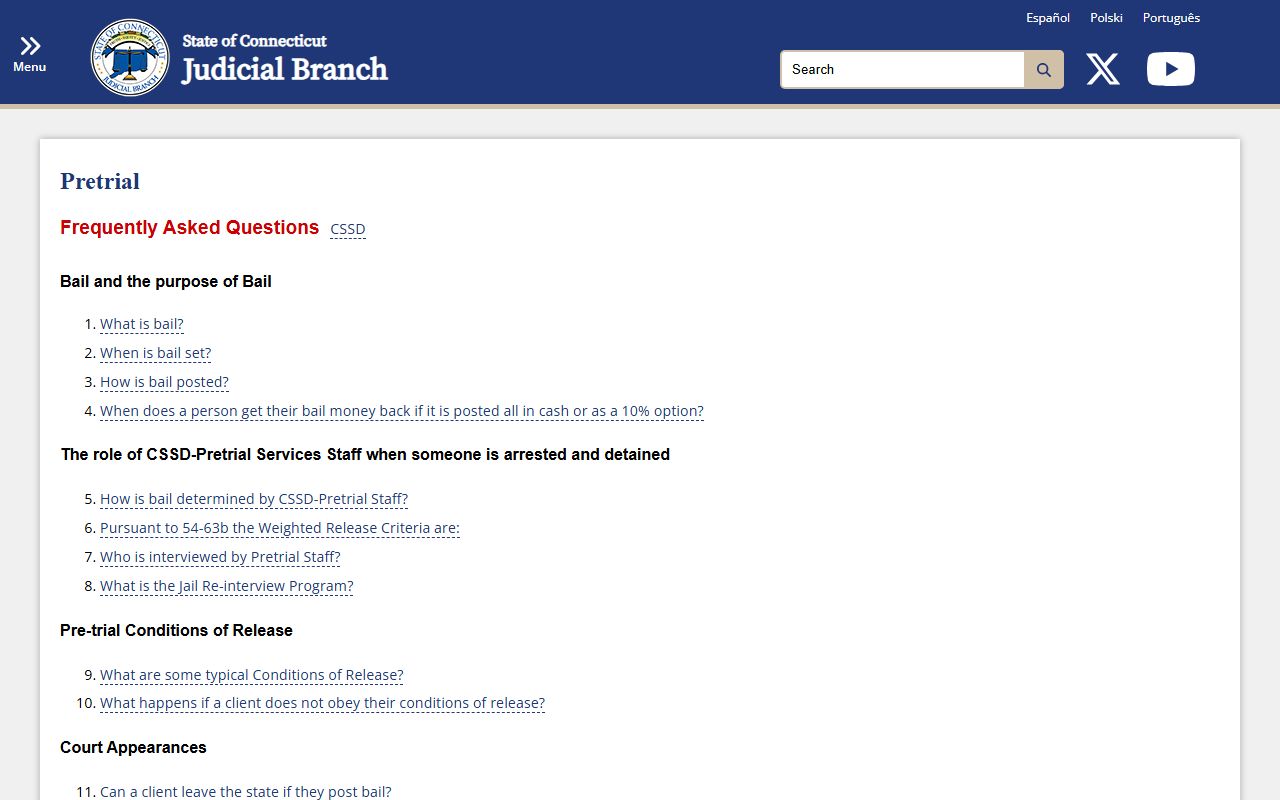
The official bail FAQ lists the release options below.
| Bond Type | How It Works |
|---|---|
| Promise to Appear | Release on a written promise with no money required. |
| Nonfinancial Conditions | Release with rules such as supervision, no contact, treatment, or travel limits. |
| Bond Without Surety | A bond obligation set without a commercial surety. |
| Bond With Surety | A bond posted through a licensed surety or bondsperson. |
| Cash / Full Value | The full cash value of the bond paid in. |
| 10 Percent Cash Option | Available automatically for bail of $20,000 or less since January 1, 2020, with exceptions. |
| No Release / Hold | Caused by warrant terms, a court order, a violation, or another agency hold. |
The release decision rests on statute. Under Conn. Gen. Stat. §§ 54-63b through 54-63d, bail staff and intake specialists weigh the least restrictive condition that secures appearance. Cash or ten-percent money comes back when a diversionary program is granted, when the person is acquitted, when the charge is dismissed, or at sentencing. Verify license status of any bond agent through the state, not a jail advertisement.
Note: Posting bail does not erase the court record; the case and its filed charges still appear in the case lookup until disposition and any later erasure.
Warrants and Failure to Appear
Warrants are a common reason a person ends up booked. Connecticut publishes some warrant data through state channels, though the case lookup is not a full warrant-clearance system. The clearest official tool covers violation-of-probation warrants. The state arrest-warrant data page lets you search outstanding violation-of-probation warrants by name, town, court location, or any mix of the three. That page is shown below.
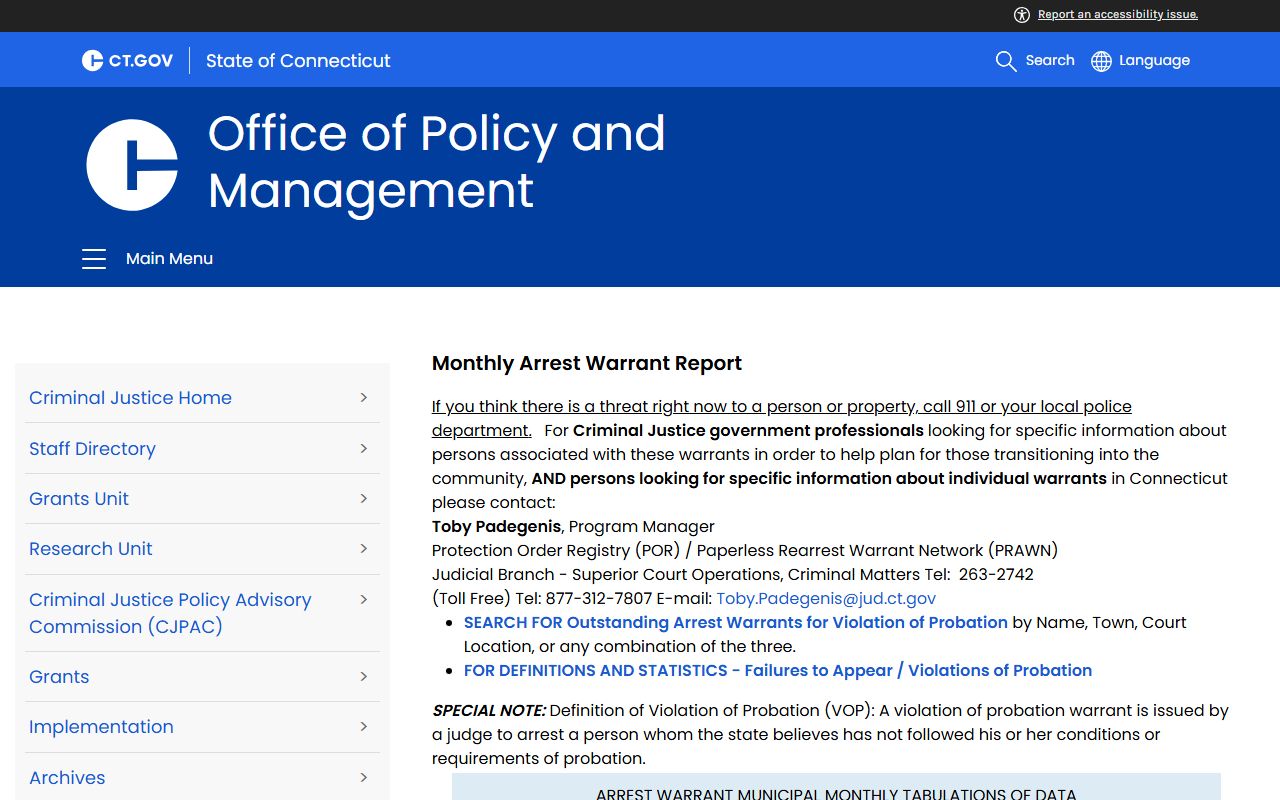
You can reach the search through the state's outstanding arrest warrant data page. Several warrant types can lead to a booking.
- Arrest warrant: a judge authorizes an arrest on probable cause.
- Bench warrant: a court issues it, often for a missed court date or court process.
- Rearrest warrant or capias: it can issue after a failure to appear or bond forfeiture.
- Violation of probation warrant: issued when the state believes probation rules were broken.
Statute drives these warrants. A judge may issue a bench warrant on a prosecutor's application under Conn. Gen. Stat. § 54-2a when an affidavit shows probable cause. A rearrest warrant or capias for failure to appear rests on §§ 54-2e and 54-65a, and a bond forfeiture under § 54-65a can lead straight to a capias. A warrant arrest may not show in the state inmate search until custody transfers and the daily update runs.
Arrest Charges vs. Filed Charges and Convictions
An arrest is an accusation, not a verdict. The custody record may list a controlling or arrest offense and an accused status. The court record shows the charges the prosecutor actually filed, the court dates, and the disposition. Those filed charges can differ from the arrest allegation. A conviction is a separate step that requires a plea or a finding of guilt. The table sets the two stages side by side.
| Charge | Conviction | |
|---|---|---|
| Stage | Accusation after arrest | Plea or finding of guilt |
| Proof Needed | Probable cause | Beyond a reasonable doubt |
| Where It Shows | Pending case lookup | Convictions search |
| Final? | No, still open | Yes, once disposed |
This matters for the state inmate search too. A person held before trial is accused, not convicted. Bridgeport Correctional Center holds many pretrial people, so a custody listing alone never proves guilt. Read the court disposition to learn the real outcome.
Erasure, Sealing, and Case Display Limits
Connecticut does not use the word expungement. It uses erasure. Under Conn. Gen. Stat. § 54-142a, police, court, and prosecutor records are erased after a qualifying disposition. That includes a not-guilty finding, a dismissal, a nolle that has aged past the statutory period, a pardon, and other listed outcomes. Once a matter is erased, it can disappear from public view and become legally non-disclosable. The table contrasts the two ideas readers often confuse.
| Sealed / Limited Display | Erased | |
|---|---|---|
| Public View | Hidden or withheld from the public lookup | Treated as if the matter never occurred |
| Disclosure | Restricted | Legally non-disclosable |
| Trigger | Display limits, category rules, court order | Qualifying disposition under § 54-142a |
The online lookup carries its own limits, separate from erasure. Conviction data generally shows no more than ten years after sentencing. Youthful offender, juvenile, infraction, and violation matters are not displayed the same way. Criminal history changes daily because of erasures, corrections, pardons, and other edits. So a record that appears today may not appear next week.
Note: The online lookup is a public service and not the official court record, so an erased or limited case may still need direct confirmation from the court that holds the file.
Background Check Considerations
Casual court lookups and formal background checks are not the same thing. The Judicial Branch lookup is a convenience tool, and it warns that it is not the official record. A regulated background check must follow the federal Fair Credit Reporting Act and use a licensed consumer reporting agency. Connecticut erasure law also limits what may be reported on a person whose case was erased. Treat any court-lookup result as a starting point, then confirm with the originating office before relying on it.
Important: Stamford County Inmate Population is not a consumer reporting agency under the FCRA, and nothing here may be used for employment, housing, credit, or insurance screening.
Where to Request Older or Official Stamford Court Records
When the online lookup does not show a case, or you need the official record, go to the court directly. The Court Records FAQ says a written criminal or motor vehicle record search should start at the geographical area court where the arrest happened. For a Stamford arrest, that means GA No. 1 at Stamford, 123 Hoyt Street. Include the person's name, date of birth, and the arrest or disposition date when you can. Bulk criminal data exists for a fee, but it carries daily-update and erasure-deletion duties, so it is not a practical route for a single record.
Several official offices cover different parts of the record. Use the one that matches your question.
- Court case lookup and written record search: Connecticut Judicial Branch, GA No. 1 at Stamford, Chief Clerk (203) 965-5208.
- Prosecutor and charging questions: Office of the State's Attorney, Stamford/Norwalk, (203) 965-5215.
- Arrest or incident report: Stamford Police Records Division, (203) 977-4409.
- State custody status: Connecticut Department of Correction Public Information Office, (860) 692-7780.
Victim services run on a parallel track. The Judicial Branch Office of Victim Services Helpline is 1-800-822-8428, Monday through Friday. The Stamford/Norwalk victim advocate can be reached at (203) 965-5359. These offices help victims follow a case through the court without filing a records request themselves.